


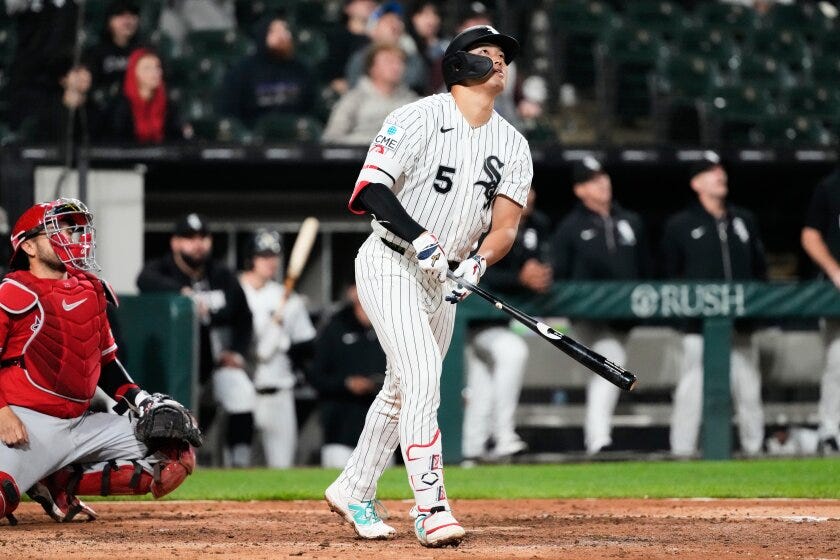
Munetaka Murakami’s posting and free agency was one of the most polarizing in recent memory.
Some considered him to be a generational power hitter. In 2022 as a 22-year-old, he hit 56 home runs for Nippon Professional Baseball’s Yakult Swallows. After missing the first few months of the 2025 season with an oblique injury, Murakami returned to hit 22 home runs in just 224 plate appearances. No hitters except for Shohei Ohtani and Hideki Matsui had come to Major League Baseball from Japan with as much of a power-hitting pedigree.
But there were concerns, especially about his swing-and-miss and ability to handle velocity. Murakami’s Zone-Contact Rate, one of the most useful advanced metrics for contextualizing swing-and-miss, was 73% in NBP last season. The mean Zone-Contact Rate among qualified hitters in MLB this season is 84%. His contact rate on fastballs over 93 mph since 2022 was 63%, a figure that at first glance is a potential cause for concern given how much faster pitchers in MLB generally throw than the pitchers in NPB.
There were also some misleading numbers floating around social media exaggerating Murakami’s struggles against velocity, which while unlikely to have impacted front offices’ views of him changed his overall public perception.
At the start of the offseason, MLB Trade Rumors projected Murakami to sign an eight-year, $180 million contract. That is a significant gap between the two-year, $34 million contract he ended up signing with the Chicago White Sox after the market he expected to find never materialized.
Murakami has gotten off to a scorching start with the White Sox and has more-than outplayed his contract so far, utilizing the same type of “three true outcomes” baseball that he was so good at in NPB. He is second in MLB with 14 home runs and seventh in walks (28), but is second in strikeouts (55). 14 of his 31 hits have been home runs and he has just one non-homer extra-base hit, a double, which he hit on Monday, the 35th game of his Major League career.
A player Murakami has frequently been compared to? Three-time All-Star Kyle Schwarber, who finished second in National League MVP voting last season.
Here is how Murakami’s 2026 stats stack up to Schwarber’s:
Murakami: 14 HR, 28 BB, .237/.369/.565
Schwarber: 11 HR, 26 BB, .207/.352/.519
All of the concerns about velocity also appear to be overblown. After his home run on Monday against a 98.1 mph fastball, Murakami is the only player this season to have multiple home runs off of 98.0 mph+ pitches. Like most elite hitters, Murakami was able to adjust perfectly fine to the increased velocity at the next level.
So, how is Murakami having such a productive season? The swing-and-miss is clearly still there. His Zone-Contact rate this season is even lower than it was in Japan, 65.3%, the worst among qualified hitters. He also has the highest Whiff Rate at 43.9%, which is something you do not usually see for someone who walks as much as Murakami.
Murakami has elite plate discipline, and when he makes contact, he makes the most of it. He has the best Hard-Hit percentage in the league at 63.6%. He has the fourth-highest Barrel Rate at 22.1%. When Murakami sees a ball outside the zone, he rarely swings. His Out of Zone Swing Rate is 22.0%, 24th among qualified hitters.
Even if it may not be the most exciting brand of baseball, Murakami has mastered the “three true outcomes” of home runs, strikeouts and walks and has been one of the most impressive hitters in baseball in just his first month in the Majors.
Were front offices right to worry about his strikeouts? Maybe. That part of his game is still present, and will likely not go away any time soon. But it does not matter. Murakami is still hitting home runs and getting on base.
Here is where things could get interesting.
While the White Sox have made some significant strides and are just 1 ½ games back of the Cleveland Guardians in a surprisingly weak AL Central, they have a 17-20 record and do not look like they are ready to be considered true contenders.
Chicago could capitalize on Murakami’s play, low salary and team control through next season and sell extremely high on him at the trade deadline. The Seattle Mariners, St. Louis Cardinals, Milwaukee Brewers, Pittsburgh Pirates and San Diego Padres are all teams that could look to upgrade at the corner infield or DH spots.
It was likely not Murakami’s first choice to sign with the White Sox, a team that is just one season removed from a historic 121-loss 2024 campaign. Almost every other team in baseball probably had a chance to beat the White Sox’s offer and sign Murakami themselves.
If the White Sox do decide to make their Japanese superstar available, there will be no shortage of suitors who would make sure not to make the same mistake twice and pass up an opportunity to acquire Murakami.
This was such a good gamble by the White Sox. Plate discipline and power is a great combo.
I think Murakami has played as an MLB slugger from the start of his career in Japan - he always had elite power and a tendency toward a high whiff rate, walk rate, and a low average. The year he won the Triple Crown (2022) is an outlier - his average in other seasons were: .231, .307, .278, .256, .244, .273 - not too bad, but not perennial Triple Crown numbers by any means.